
While many businesses are struggling to gain recognition from the new generation, some are achieving it easily. Some are falling behind by ignoring ChatGPT’s ranking.
I was doing the same until I clearly knew that AI SEO is going to dominate the future. Overall search behaviour is changing, so is the ranking system. I was not sure about where to start; I had no idea if this was even possible or not. Then I started researching this topic deeply, watched hundreds of videos on this, and followed the biggest creators’ instructions in the SEO industry.
When I found out that content is the main key, I quickly went to ChatGPT and asked it to write me a bunch of content so I could publish it effortlessly and get recommended by ChatGPT itself, funny, right? I thought it was genius at the time. But I realized, it’s not only about writing or generating content from ChatGPT. It’s about optimising it.
Because here’s the “one big issue” I found: ChatGPT is confidently wrong, a lot.
In fact, recent studies in 2025 show it can be inaccurate in as many as 1 out of 4 answers. In specialized fields like coding, some studies found that it was wrong over 52% of the time. Even the team at Moz published a post about how ChatGPT gave them bad SEO advice.
This inaccuracy isn’t a flaw; it’s your single biggest marketing opportunity.
The AI needs accurate, well-structured, authoritative content to fix its own weaknesses. Your job is to provide that. After going through this article, you will learn my own strategy from over 2 years of experience in SEO about optimizing your content to be the trusted source for Google and ChatGPT.
AI SEO Over Traditional SEO
We only watched AI in The Matrix or in Mission Impossible movies, but who thought it would dominate the world, change how people use the internet totally! AI not only changed the Search Behaviour, but it also changed how SEO works. The SEO game is not the same as before anymore; you can say it has turned over to a new way.
After the AI evolution, it opened a whole new door to the SEO field. People are now experimenting with their business’s SEO with different AI tools. The most noticeable change here is that we don’t need to follow the same strategy anymore; we can create our own strategy of doing SEO and dominate AI search results.
Traditional SEO
It is making me nostalgic already, talking about traditional SEO. People’s search behaviour was not the same as nowadays. If anyone needed to know anything or purchase anything, they used to search on Google with their specific need.
Let’s say you want to buy a new baseball bat for your 10-year-old son. You would search on Google to find out the best baseball bat for your 10-year-old son, and a lot of websites/articles would show up on the search page (mostly 10). You would go through each site, read the posts, and know which one would be best. Most of the site gives links to purchase the product they’re reviewing. This was how the search worked back in time. And the goal was to make your website show up on the first page (top 10 results) of Google.
Traditional SEO used to be Simple:
You audit a website, do keyword research, fix technical issues, create a content plan, build countless backlinks on the pages, and wait for the website to show up on Google. Backlinks were a huge deal back in time; Google used to think that the website that had more backlinks was more trusted and ranked in the first position.
Answer Engine Optimisation (AEO)
We are in the AI Boom era, and our search behaviour and how we use the internet have totally changed. In the past, people used to go through a bunch of sites to get what they wanted, but now AI can do it for them.
If Gen-Z needs to know anything, they go to ChatGPT/Gemini/Grok or any other LLM to ask questions and directly get answers for that. If they want to purchase anything, they directly go to Amazon or other large e-commerce sites, search for their desired product, and read reviews to understand if it’s a good choice or not.
Ultimately, Gen Z uses different platforms for different purposes. Now TikTok is getting bigger for purchasing things, which is unbelievable! Now the goal is to get listed on ChatGPT, Google, and everywhere else where their potential customers could go.
SEO is not only Search Engine Optimisation anymore, it’s Search Everywhere Optimisation.
If you prefer watching a video, you can consider watching the video below. But if you are a reader, please continue.
How does ChatGPT work for SEO?
Alright, so how does this new world even work? If it’s not Google, what is it?
The first thing you have to understand is that ChatGPT isn’t googling in real time (at least, not in the way you think). It was built on a massive, static pile of data. Its knowledge was basically a snapshot of the internet from a few years ago.
Now, things are changing fast.
The New Atlas Browser
You’ve probably heard about ChatGPT’s new Atlas Browser. This is a total game-changer. It’s not just a browser like Chrome; it’s an answer engine with an AI agent implemented into every single tab.
Instead of you searching, clicking a link, reading, and hitting back, Atlas can do it all for you. You can be on a page and ask the sidebar, “Summarise this for me,” “Compare this product to the one I had in my other tab,” or “Find me the main arguments in this article.”
This compresses the entire sales funnel. The user might get their answer without ever clicking on your site. That’s why you can’t just be a link anymore. You have to be the source for the AI’s summary.
How the Browsing Feature Actually Works?
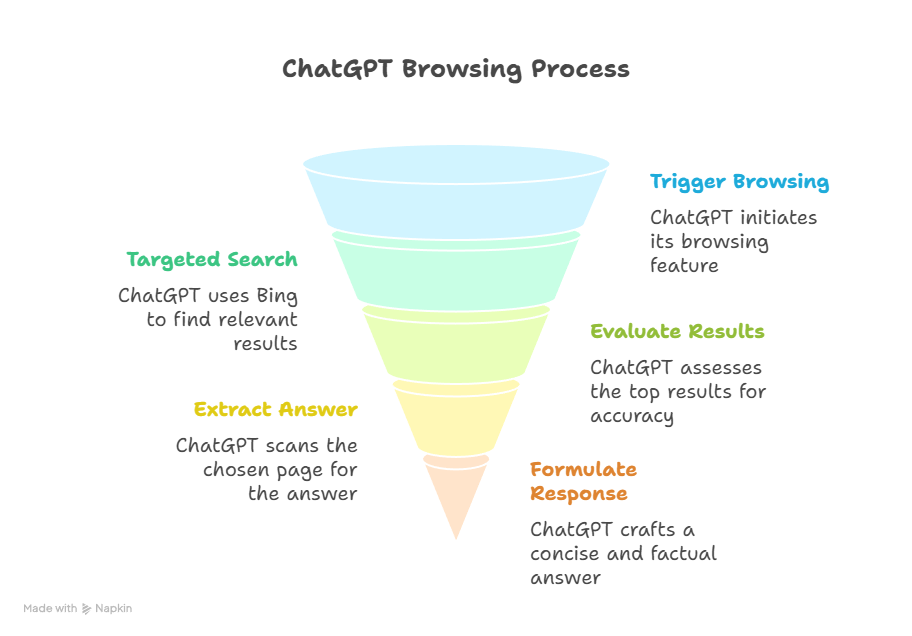
So how does this browsing thing actually work? It’s not opening up a Chrome tab and scrolling like you or me. That’s the first and most important thing you have to get in your head.
When you ask ChatGPT a question, it can’t answer from its old, static brain (like “who won the game last night?” or “what are the latest AI-SEO trends?”), It triggers its browsing feature to crawl multiple websites and provide data to the user.
I like to say it “plunders,” it doesn’t “browse.”
Here’s the breakdown:
- It’s looking for a specific answer to a specific question. It’s not there to read your “About Me” page or admire your design.
- It uses Bing, and guess what it’s using to find that answer? Bing. Yep. It runs a quick, targeted search on Bing, looks at the top 3-5 results, and decides which one is the most likely to have the answer.
- It “Plunders” the Answer. It then scans that page, takes the information it needs, and uses that to formulate its answer. It’s looking for the most concise, factual, and clearly written text that matches the user’s prompt.
So what does this mean for you? It means you have about one second to impress it. Your content can’t be buried in fluffy intros or long stories. The answer has to be right there, on the surface, in the first or second paragraph, ready to be “plundered.”
If the AI has to work to find your answer, it will just leave and go to your competitor’s site, which is clearer.
Why E-E-A-T is 10x More Important for AI
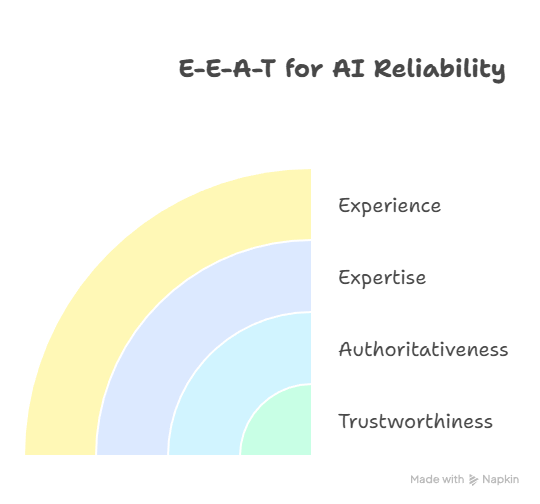
You’ve heard about E-E-A-T (Experience, Expertise, Authoritativeness, Trustworthiness). For traditional Google SEO, it was this vague, important-sounding thing. For AI? It is the entire game. I’m not exaggerating. The simple, brutal truth is that an AI is a “black box.” It doesn’t know what’s true; it’s just an incredibly advanced prediction machine trying to sound correct. Its single biggest weakness, the one that keeps its developers up at night, is that it can be confidently wrong. Remember my 27.41% inaccuracy stat? That is the AI’s monster in the closet, and it knows it has this problem.
Because the AI is terrified of being wrong and looking stupid, it is desperate to find signals of trust. It’s actively hunting for proof that the information it’s about to give is reliable. Your E-E-A-T signals are no longer just “good practice.” They are a lifeline for the AI. When you make your E-E-A-T obvious, the AI will grab your content and cite you because you make it look smarter and more reliable.
This is where your human content becomes irreplaceable. The AI can’t experience a product, so when you write “My case study showed…” you are providing a unique perspective that it cannot generate. The AI can’t think like an expert; it just summarizes what other experts have said. When you write a deep-dive “Comp vs. Comp” post, you’re not just stating facts; you’re providing analysis, which proves your expertise. This all builds your authoritativeness, as the AI sees you as a “known entity” and a “safe bet,” especially if you have a clear author bio and are mentioned by other trusted sites. This all boils down to trust: a secure, fast site with accurate, verifiable information is a low-risk, high-reward source for an AI. For Google, E-E-A-T was a ranking factor. For AI, it’s a fundamental requirement.
Core AI Optimisation Principles
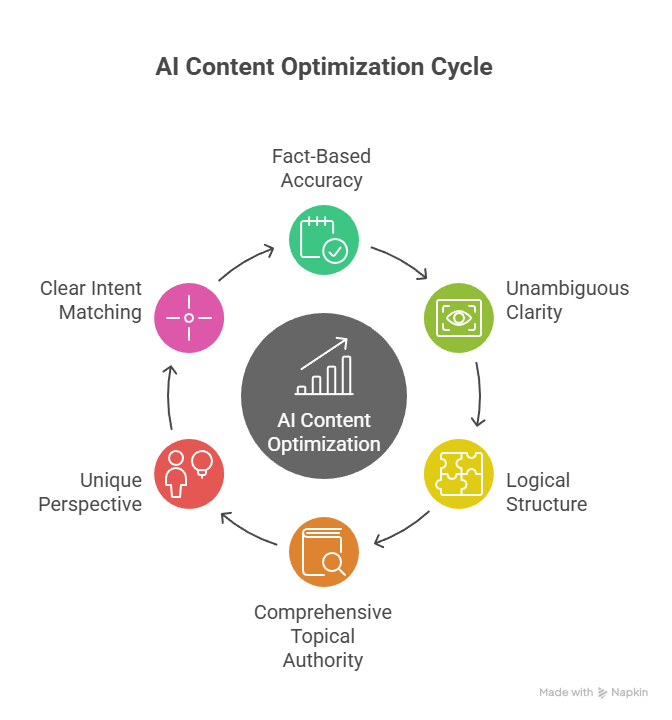
After I realized that just publishing raw AI content was a dead end, I went back to my 2+ years of SEO experience. I found that the rules for AI are just a smarter, stricter version of the rules we’ve always had. It’s not a trick; it’s about being the best, clearest, and most trustworthy source.
Here are the 6 core principles I built my entire strategy on.
Principle 1: Fact-Based Accuracy
This is the foundation. Both AI and Google are trying to provide correct answers. If your content is filled with facts, real data, and you’re not just making stuff up, you signal that you’re a trustworthy source. You can’t just have an opinion; you have to back it up. When the AI sees that your information is accurate, it learns to trust you. And when it trusts you, it’s more likely to recommend you.
Principle 2: Unambiguous Clarity
You have to remember, you’re writing for a machine and a human. The AI is smart, but it gets confused by “fluff,” sales-y language, and super-complicated sentences. It reads things very literally. You need to be direct. Use short sentences. Use simple words. Get to the point. If the AI has to “guess” what you mean, it will just get confused and move on to a simpler, clearer article.
Principle 3: Logical Structure
This one is simple but so important. An AI “reads” your article by looking at your headings (your H1, H2s, H3s). This is its “roadmap.” It uses your headings to understand what your article is about and how all your ideas are connected. If you just use headings because they look good, but they’re in the wrong order, the AI gets lost. A clean, logical outline is one of the easiest ways to help the AI understand (and rank) your content.
Principle 4: Comprehensive Topical Authority
This is a big one. You can’t just write one article about “SEO tools” and expect the AI to see you as an expert. You have to prove it. You have to cover the entire topic. This is exactly why my “Comp vs. Comp” posts (like MarketMuse vs. Ubersuggest) work so well. They prove I don’t just know about one tool; I know about the whole subject. When you do this, the AI sees you as a true authority, the “go-to” person for that topic
Principle 5: Unique Perspective
This is the one thing the AI cannot copy. This is what stops you from being just another AI-generated post. The AI has read the entire internet, so it knows all the generic advice. What it doesn’t know is your personal story, your “I tried this and here’s what happened” case study, or your unique opinion on a trend. This “human” part is your secret weapon. It proves your Experience and Expertise (the “E-E” in E-E-A-T) and makes your content 100x more valuable.
Principle 6: Clear Intent Matching
This is classic SEO, but it’s even more important now. You have to stop just thinking about “keywords.” You have to start thinking about “questions.” People don’t just search for “AI SEO”; they ask, “How do I optimize my content for AI?” Your job is to answer that exact question as clearly and completely as possible. This is why FAQ sections at the end of posts are so powerful now. You are directly answering the user’s question, and the AI loves that.
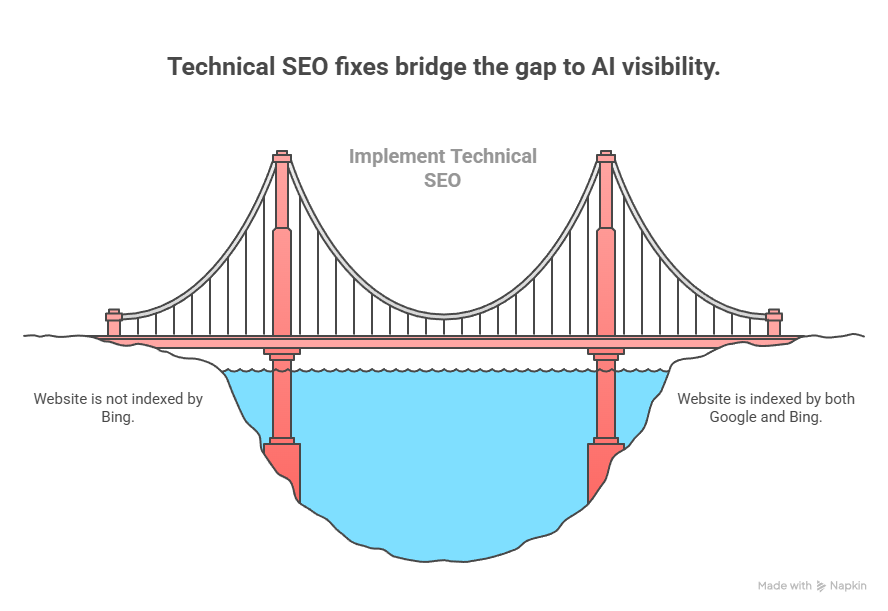
Essential Technical Fixes to Consider
Alright, when I say “technical,” don’t panic. I’m not a developer, and you don’t need to be one either.
For me, technical SEO just means making our website clean, fast, and easy to read. It’s about housekeeping. This is important for humans, it’s important for Google, and now, it’s critical for AI.
And here’s the new reality: You must be indexed on both Google and Bing.
Why Bing all of a sudden? Because that’s what ChatGPT’s browsing feature uses to find current information. If you’re invisible on Bing, you’re invisible to the AI.
These fixes aren’t about code; they are about clarity. They will help you get seen everywhere.
Maintain Content Structure
I know I mentioned this in the principles, but I’m saying it again here because it’s a technical fix that you control. Your headings (H1, H2, H3) are the skeleton of your article. An AI, Google, or Bing crawler reads this skeleton first to decide what your content is about. If your headings are a mess (like using an H2 just to make text big), you confuse them. A clean structure is the easiest technical win you can get. H1 for the title, H2s for main ideas, H3s for sub-points. That’s it. It’s that simple.
Schema Markup Implementation
This sounds super technical, but it’s not. Think of Schema as a “dictionary” or a set of “price tags” for the AI. You’re explicitly telling the search engines what your content is. You’re saying, “Hey, this part is an FAQ,” or “This is an Article,” or “This is a How-To guide.” You are removing all the guesswork. When the AI is browsing and needs an answer fast, it’s going to grab the content that is clearly labeled. You can use free WordPress plugins for this; you don’t need to code it.
Clean Internal Linking
This is a classic, and it’s more important than ever. Think of your links as “bridges” that show the AI (and Google, and Bing) how your ideas are connected. When I write this post and link to my MarketMuse vs. Ubersuggest post using the anchor text “content optimization tools,” I’m doing two things. First, I’m helping the user. Second, I’m telling all the crawlers, “Hey, I’m an expert on content optimization tools… I even wrote a whole other post about it!” It builds your topical authority and helps the crawlers find all your best content.
Core Web Vitals & Page Speed
This one is common sense. A slow, clunky, or broken-on-mobile website is a “low-trust” signal. Both users and crawlers hate it. If your site takes 10 seconds to load, the AI crawler (and the human user) will just give up and leave. You don’t need to be a developer to fix the biggest problems. Just compress your images, don’t use 20 different fonts, and choose a good, fast web host. A fast site signals professionalism, and both Google and AI love professionalism.
Best AI Tools to Optimize Content for Ranking
I’m an expert in this, and I’ve tested everything. Remember my “genius” idea to just have ChatGPT write all my content? That failed because I was using AI for the wrong thing.
You can’t just use AI to write; you have to use AI to optimize.
These are the tools I actually use and respect for that job. They help you build content that is so comprehensive, well-structured, and authoritative that both Google and AI have to pay attention.
Surfer SEO
I’ve used this one a lot. Surfer is amazing for traditional SEO, but it’s also a secret weapon for this new AI-first world. It’s not just guessing. It goes out, analyzes the top-ranking pages right now, and gives you a data-driven “blueprint” of what to include. It tells you the keywords to use, the ideal word count, and what headings to add. For an AI, this data-rich, comprehensive, and well-structured content is exactly what it’s looking for.
Frase AI
Frase is fantastic for research and building your content briefs. Its superpower is that it can “read” the top 20 search results in seconds and build you an outline based on the questions people are actually asking. It’s like an “intent-matching” machine. This is perfect for our “Principle 6: Clear Intent Matching” because it helps you build those powerful FAQ sections and answer every possible question a user (or an AI) might have.
MarketMuse
This is the enterprise-level beast, and I’ve spent a lot of time with it. As I wrote in my MarketMuse vs. Ubersuggest post, this tool is all about topical authority. It’s not just for one article. MarketMuse uses AI to analyze your entire site and find “gaps” in your knowledge. It shows you what questions you haven’t answered, helping you build that comprehensive authority that AI platforms are so desperate to find. It directly helps you achieve “Principle 4: Comprehensive Topical Authority.”
Advanced Content Strategy for AI Platforms
Alright, this is my favorite part. This is where we take all those principles and fixes and combine them into a strategy that actually wins.
This is how you stop just “making content” and start building a real, authoritative brand that both AI and Google have to respect. After all my testing, these are the exact content formats and strategies I use for my own site.
AI-Powered Keyword Research
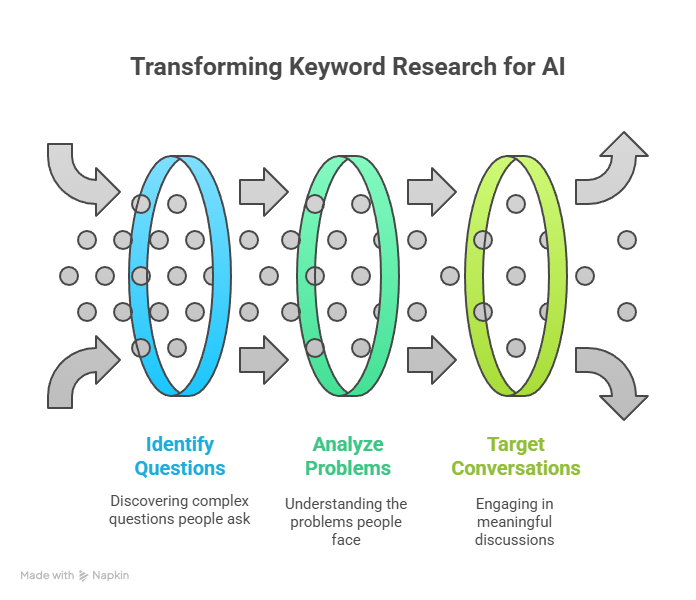
First things first, your old way of keyword research is incomplete. You can’t just look for “keywords” with high volume and low difficulty anymore. Why? Because AI is answering all the simple questions.
You need to start looking for questions and problems. Use your SEO tools (like Ahrefs or Semrush) to find what people are typing into the “People Also Ask” box or on sites like Reddit. These are the complex, multi-part questions the AI loves to find clear answers for. You’re not targeting a “keyword”; you’re targeting a “conversation.”
Be the Source
This is how you build a long-term “moat” around your content. The AI has read the entire internet; it knows all the generic advice. What it can’t do is create original data or have a personal experience.
“Being the source” means publishing things that only you can. This could be a unique case study (like “I tried this and here’s what happened”), a survey you ran, or your own expert analysis. When you are the only one with that data, the AI has to cite you. This is the ultimate way to prove your “Principle 5: Unique Perspective.”
Competition vs Competition
This is my secret weapon, and it is perfect for this new AI world. Think about my “MarketMuse vs. Ubersuggest” post. This format is a powerhouse for a few reasons:
- It directly answers a high-intent, complex question.
- It’s loaded with facts, features, and analysis (which AI loves).
- It instantly proves your “Principle 4: Comprehensive Topical Authority.” It shows the AI that you don’t just know about one tool; you are an expert on the entire subject.
The “Best Alternative” Format
This is another killer format that works for the same reason. When you write a “Best X Alternatives” post, you are creating a “hub” of information. You’re showing the AI, Google, and the user that you’ve done all the research for them. You’re not just an expert on one thing; you’re an expert on the whole market. This builds massive trust and authority.
The “How-To” Tutorial
This is your ultimate trust-builder. It’s how you prove your “Experience” and “Expertise” (the “E-E” in E-E-A-T). An AI can tell you how something works, but it can’t show you. A good “How-To” post, with your own screenshots and your own process, proves that you actually know how to do the thing you’re talking about. It’s a “show, don’t tell” strategy, and it makes your content 100x more valuable than any generic AI article.
FAQ
Is “AI SEO” (AEO) different from traditional SEO?
Yes, the goal is different. Traditional SEO is about ranking #1 on a list of 10 links. Answer Engine Optimisation (AEO) is about becoming the source for a single, AI-generated answer. But the fundamentals—like quality, authority, and trust—are exactly the same. They just matter more now.
Will AEO replace traditional SEO?
It won’t replace it, but it’s changing the game. They will work together. For the next few years, you’ll have to do both. You need to optimize for Google’s traditional 10-link list and for the new AI answer boxes.
How long does it take to get “ranked” in ChatGPT?
It’s not really “ranking” like in Google. It’s about being “indexed” in the AI’s knowledge. This is a long-term play. It’s not a quick trick. It happens when your site is so authoritative, so clear, and so trustworthy that the AI has to include you in its knowledge to be accurate.
Can I (or Should I) use AI to write content for AEO?
This is a trap. You can—and should—use AI to help you research, brainstorm, and create outlines. But you must add your “Principle 5: Unique Perspective.” If you just publish the raw AI draft, you’re part of the noise. It’s the fastest way to be ignored. Your human experience is the one thing the AI can’t copy.
What’s the difference between optimizing for ChatGPT vs. Google SGE?
They are very similar. Both want clear, factual, authoritative content. The main difference is that Google SGE (Search Generative Experience) is still tied to its search results page and its ads. ChatGPT is trying to be a standalone “answer engine.” The good news is, the strategy in this article—becoming a clear, trusted source—works for both of them.
Conclusion
So, here’s the bottom line.
The AI boom isn’t something to be scared of—it’s the biggest opportunity we’ve had in a decade. While everyone else is either ignoring it or (worse) spamming the internet with bad AI content, you now have a clear playbook.
Stop thinking about “Search Engine Optimisation.” Start thinking about “Search Everywhere Optimisation.”
Focus on being the most accurate, authoritative, and structurally clear source in your industry. Stop trying to “trick” the algorithm and start helping the AI be smarter.
When you do that, it won’t just recommend a source. It will recommend you.